
Diablo 4 Horadric Cube Guide: Recipes, Materials, and Crafting Explained



-
Bundle
-
Hot
If you played Diablo 2, you already know the Horadric Cube. The Cube is back in Diablo 4 with the Lord of Hatred expansion, and this time it is one of the most important systems in the entire game. Once you understand it, you stop praying for perfect drops and start crafting them yourself.
This guide walks you through how the Cube works, every recipe in plain language, where to farm the materials, and the smartest ways to use it. By the end, you will know exactly what to feed it and what to avoid wasting.
- How the Cube works and how to unlock it
- Every recipe with materials and effects
- Where to farm all the dust, prisms, and trophies
- Best endgame uses for maximum character power
- Class specific tips for all 7 classes
Quick note: Lord of Hatred is fresh content, so a few exact values may shift in early patches. Where the live build is still settling, we use careful wording. Everything else is what we have seen confirmed in current footage and trusted databases.
CAMPAIGN SERVICES
How the Horadric Cube Works
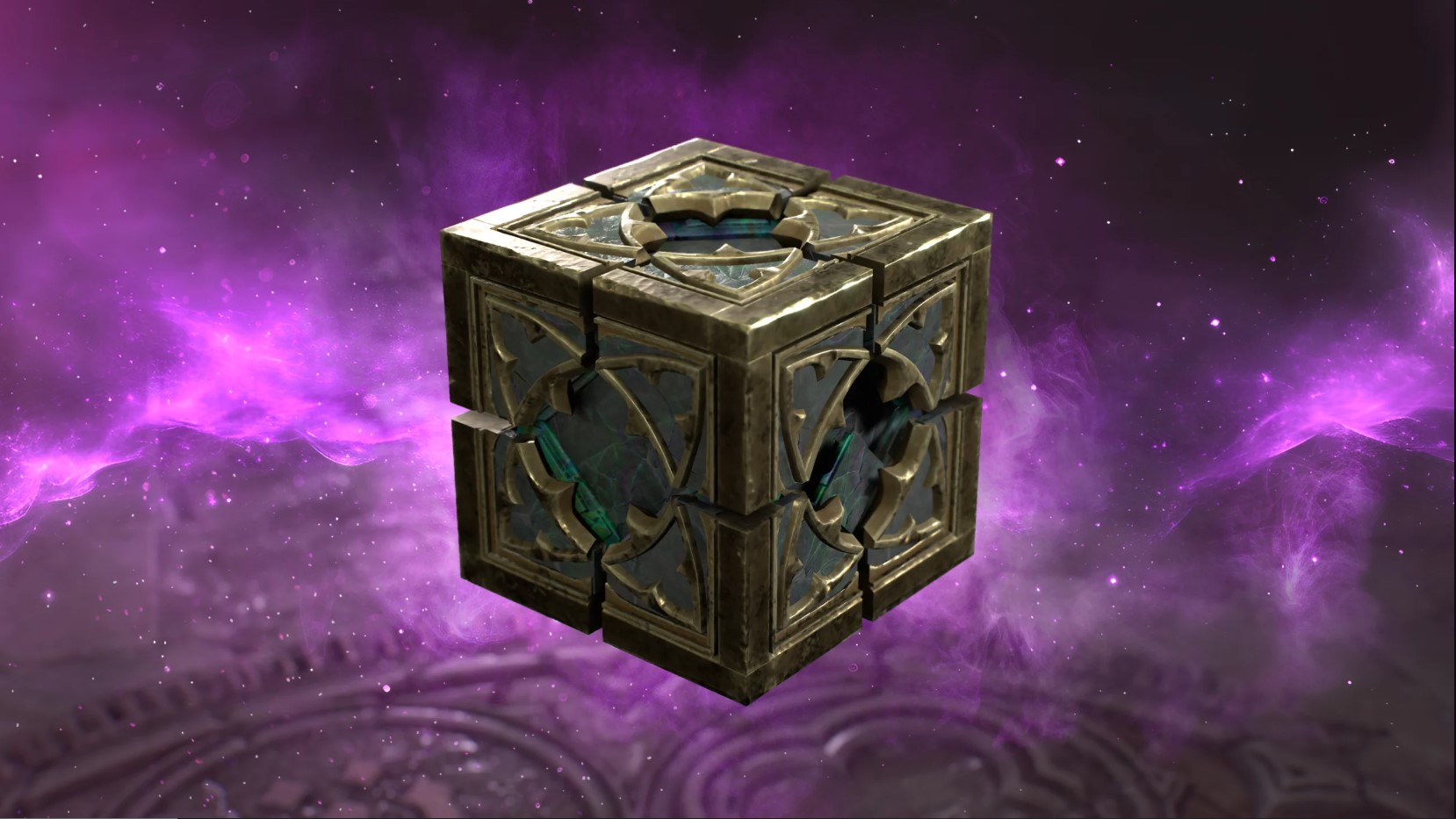
The basic idea is simple: drop in a piece of gear plus rare materials, hit transmute, and the Cube hands you back something better. Every recipe has its own input requirements and material costs, but the loop is always the same.
What you put in matters a lot. The Cube is the bridge between trash drops and endgame gear, and the rarity of your input directly shapes the rarity of your output.
- Feed it a Common, you can pull a Unique
- Feed it a Rare, you can push it to a Legendary
- Feed it a Legendary or Mythic, you can transfigure it into something completely different
- Feed it duplicates, you can recycle them into a fresh roll
Recipes, Materials and the Transmute Mechanic
Every action you do in the Cube is called a recipe. Each one has a fixed material cost and a clear output, and most of them are infinitely repeatable as long as you keep the materials flowing.
There is no daily lock or weekly cap on Cube use. Materials drop from the world early, so you should start stockpiling them well before you finish the campaign.
- Primordial Dust: the universal Cube currency, eight tiers
- Tuning Prisms: the steering wheel for reroll outcomes
- Horadric Resin: dedicated Charm crafting material
- Boss Trophies: Amalgamation inputs from lair bosses
Tuning Prisms and How They Control Outputs
If recipes are the engine, Tuning Prisms are the steering wheel. Without one, most reroll and transfiguration recipes are pure RNG. With one, you point the Cube at a specific affix family.
There are eight Tuning Prism types in total. Based on current sources, they share a similar drop pool: War Plan caches, Tree of Whispers rewards, and elite monsters across any Tormented tier.
- Aggressive Tuning Prism: Offensive affixes (damage, crit, vulnerable damage)
- Protector's Tuning Prism: Defensive affixes (armor, max life, damage reduction)
- Resourceful Tuning Prism: Resource affixes (mana, fury, energy generation)
- Adept's Tuning Prism: Skill ranks and core stats
- Pragmatic Tuning Prism: Mobility and utility (movement speed, cooldowns)
- Chromatic Tuning Prism: Resistances
- Entropic Tuning Prism: Transfiguration material (broad outcomes)
- Kullean Tuning Prism: Transfiguration material (Legendary Aspect on amulets, lowers Unmodifiable risk)
Pro Tip: When you transfigure an amulet, always run a Kullean Prism. Without one, current sources suggest the result is almost always Unmodifiable, which essentially bricks the item.
Why White, Magic, and Rare Items Matter
Most players ignore Magic and Rare drops past level 30. With the Cube in the picture, that habit is going to cost you serious gear.
Yellow and blue items are the cheapest fuel for Add Affix, Upgrade to Legendary, and 3 to 1 Transmutation. Common (white) items are even more important than people expect, since they are the only input that can transmute into a random Unique.
- Stop salvaging blues and yellows on sight
- Pick up commons in slots you actually care about
- Treat every drop as crafting fuel until proven otherwise
- Adjust your loot filter to keep at least one of each rarity tier visible
How to Unlock the Horadric Cube
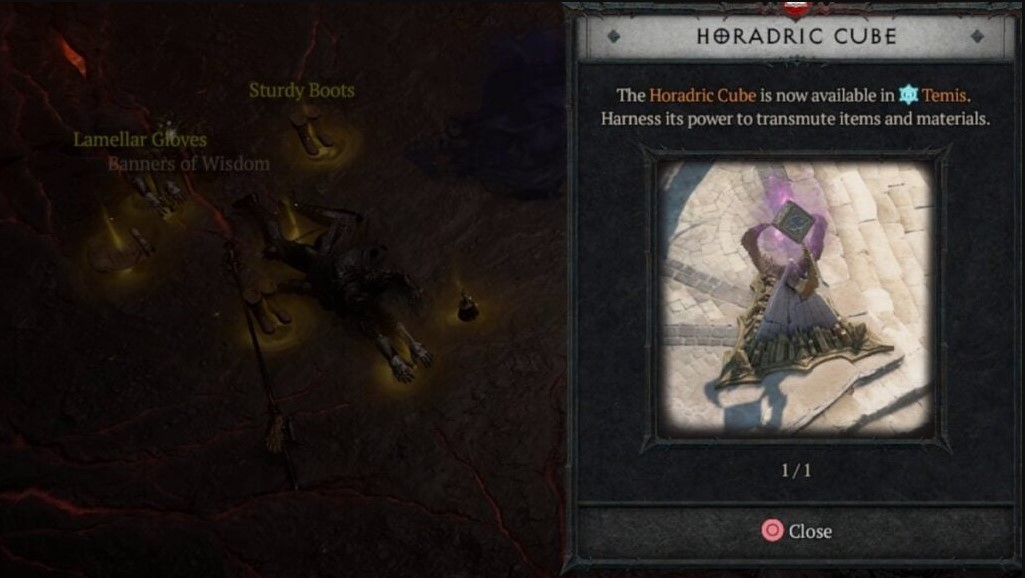
You will not have access to the Cube right away. It unlocks toward the end of the Lord of Hatred campaign, so if you skipped story content, you are going to want to come back for this one.
Quest Path and Requirements
Based on current sources, the Cube unlocks at the end of The Land of Fire questline, which is the final region of the Lord of Hatred campaign. The exact final quest step should be verified once official databases are fully updated.
After the campaign, you also play through a short tutorial intro that walks you through the Cube interface. Once that is done, the full recipe list opens up and the Cube is account wide.
- Gate: Lord of Hatred campaign completion
- Tutorial: short intro quest after the campaign
- Scope: account wide once unlocked
First Time Setup
The Cube lives in town and is accessed from your stash menu in any major hub. Materials drop from the world fairly early, so by the time you finish the campaign you should already have a small stockpile waiting for you.
Your first priority is collecting Raw Primordial Dust and at least one Tuning Prism of each affix family. Both are needed for almost every meaningful recipe.
- Finish the Lord of Hatred campaign
- Complete the short Cube tutorial that follows
- Open your loot filter and stop hiding Magic and Rare drops
- Start farming Primordial Dust through War Plans and Tree of Whispers
- Pick up at least one Tuning Prism of each affix family before you start crafting
Transfiguration Explained
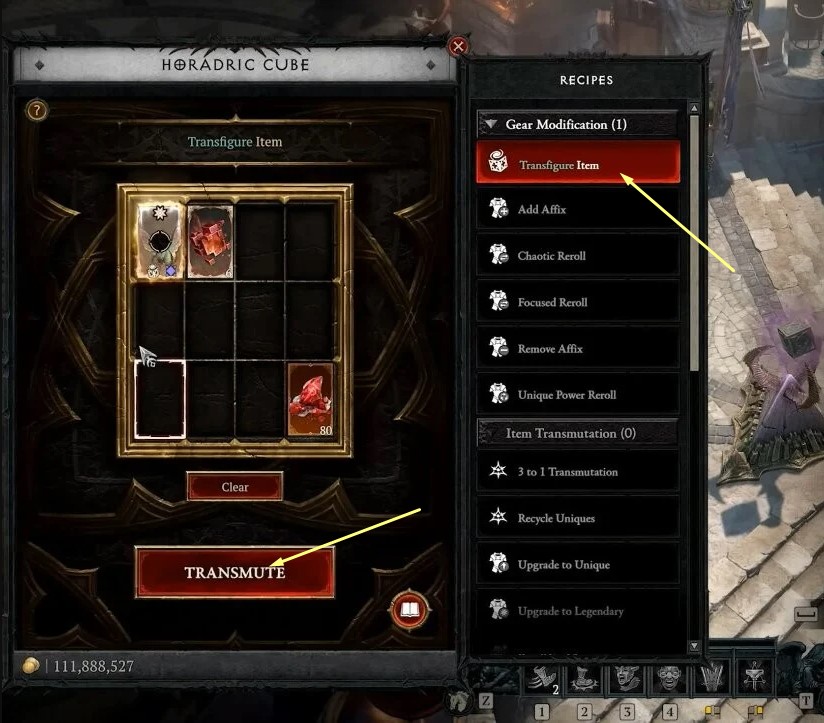
Transfiguration is the most powerful Cube recipe in the game and also the riskiest. It takes a Legendary, Unique, or Mythic item and rolls a random modification on it.
The upside is huge, but the downside is that you can brick a great item if you go in unprepared. If you played Season 11, this is the spiritual successor to Sanctification.
- Upside: game changing modifications, build defining aspects on amulets
- Downside: Unmodifiable bricking risk if no Tuning Prism
- Mitigation: Kullean Tuning Prism on amulets, Entropic Prism on other gear
How Transfiguration Works
You feed the Cube one Legendary, Unique, or Mythic item plus one Volatile Primordial Dust. The Cube rolls a wide table of beneficial modifications and assigns one to your item.
Without a Tuning Prism, the gamble is broad. The roll table also includes the dreaded Unmodifiable tag, which locks the item out of all future Cube actions and tempering.
- No prism: wide RNG, high Unmodifiable risk
- Entropic Prism: narrows the table, still some Unmodifiable risk
- Kullean Prism on amulet: adds a random Legendary Aspect, very low Unmodifiable risk
The Transfiguration Amulet
If you only do one transfigure all season, make it your amulet. Adding a random Legendary Aspect to an amulet creates one of the strongest item slots in the game.
Amulet aspects scale roughly 50% stronger than the same aspect on a weapon or armor. A god rolled transfigured amulet is the difference between Torment 8 viable and Torment 12 viable for most builds.
Reminder: Save your best Legendary amulets for this recipe. Do not feed it junk amulets you do not actually want to keep.
- Best amulet candidates: Ancestral Legendary with Greater Affixes
- Skip these amulets: low item power, no Greater Affix, off slot stats
- Always pair with: Kullean Tuning Prism for Legendary Aspect roll
Kullean Tuning Prism
The Kullean Tuning Prism is the dedicated transfiguration material. On amulets, current footage suggests it adds a random Legendary Aspect to the item, which is exactly what you want.
It also drops the Unmodifiable risk dramatically. Run Kullean on every amulet transfigure. The recipe is repeatable, so you can keep rolling the amulet over and over until you land the aspect that matches your build.
- Function: adds random Legendary Aspect on amulets
- Safety: minimizes Unmodifiable risk
- Repeatability: roll the same amulet until you land the right aspect
Modifiable vs Unmodifiable Affixes
Every transfigured item gets tagged either Modifiable or Unmodifiable. The difference shapes everything you can do with the item afterward.
- Modifiable: can still be tempered, masterworked, and Cube edited
- Unmodifiable: frozen at current state forever, no further crafting
Note: Mythic Uniques can be transfigured, but the cost is steep. Save this for end of season pushes when you have spare Mythic Uniques sitting in your stash.
All Horadric Cube Recipes
.jpg)
There are four recipe categories: Crafting, Upgrade, Conversion, and Utility. Each one solves a different gear problem.
Crafting Recipes
These recipes change the affixes on existing gear without changing its rarity. They are your daily drivers for tuning a piece of gear into something usable.
| Recipe | Inputs | Effect |
| Add Affix | 1x Common/Magic/Rare/Legendary item 1x Coarse Primordial Dust 5x Raw Primordial Dust |
Adds one random affix to gear that is under the rarity affix limit |
| Chaotic Reroll | 1x Magic/Rare/Legendary item 1x Refined Primordial Dust 15x Raw Primordial Dust |
Rerolls a random affix into a different category (use Tuning Prism to focus) |
| Focused Reroll | 1x Magic/Rare/Legendary item 1x Refined Primordial Dust 15x Raw Primordial Dust |
Rerolls a specific affix to a different stat in the same category |
| Remove Affix | 1x Magic/Rare item 1x Refined Primordial Dust 15x Raw Primordial Dust |
Removes a random affix (Magic or Rare items only) |
| Unique Power Reroll | 1x Ancestral Unique 1x Attuned Primordial Dust 100x Raw Primordial Dust |
Randomizes the Unique Power roll on an Ancestral Unique |
Upgrade Recipes
These recipes promote gear to a higher rarity tier. They are the easiest way to turn an unwanted drop into something endgame ready when the loot table is not cooperating.
| Recipe | Inputs | Effect |
| Upgrade to Legendary | 1x Rare item 1x Pure Primordial Dust |
Transmutes a Rare into a Legendary with random Legendary Power |
| Upgrade to Unique | 1x Common item 1x Enhanced Primordial Dust 10x Raw Primordial Dust |
Transmutes a Common item into a random Unique of the same type |
Conversion Recipes
These recipes convert duplicates and stash bloat into something fresh. If you have three of the same Unique sitting in your bank, this is where you put them to work.
| Recipe | Inputs | Effect |
| 3 to 1 Transmutation | 3x same equipment, Talisman, or Rune type | Transmutes 3 of the same item type into 1 random new item of that type |
| Recycle Uniques | 3x same Unique equipment or Charm | Transmutes 3 copies of the same Unique into a new roll of that Unique |
| Amalgamation | Multiple of the same consumable, socketable, or dungeon key | Upgrades the input items into a higher tier version |
| Reroll Set Charm | 1x Set Charm 25x Raw Primordial Dust 50x Infused Horadric Resin |
Rerolls a Set Charm into a different Charm from the same Set |
Utility Recipes
Utility recipes cover the specialized stuff: Charms, Runes, and the high cost transfiguration entry. Not everyday recipes, but they unlock build defining items when you need them.
| Recipe | Inputs | Effect |
| Craft Unique Charm | 1x Ancestral Unique 3x Unique Charms 1x Enhanced Primordial Dust 50x Raw Primordial Dust 100x Infused Horadric Resin |
Transmutes a Unique equipment item into a Unique Charm |
| Transfigure Item | 1x Legendary/Unique/Mythic item 1x Volatile Primordial Dust |
Grants a random powerful modification (use Kullean Prism on amulets) |
| Ritual Runes | 5x Legendary Runes (any) + 5x Rare Runes + Specific Magic Rune | Crafts Bac, Igni, Tam, or Yul ritual runes |
| Invocation Runes | 5x Legendary Runes (any) + 5x Rare Runes + Specific Magic Rune | Crafts Eom, Jah, Ohm, Vex, or Yom invocation runes |
Materials and Where to Farm Them
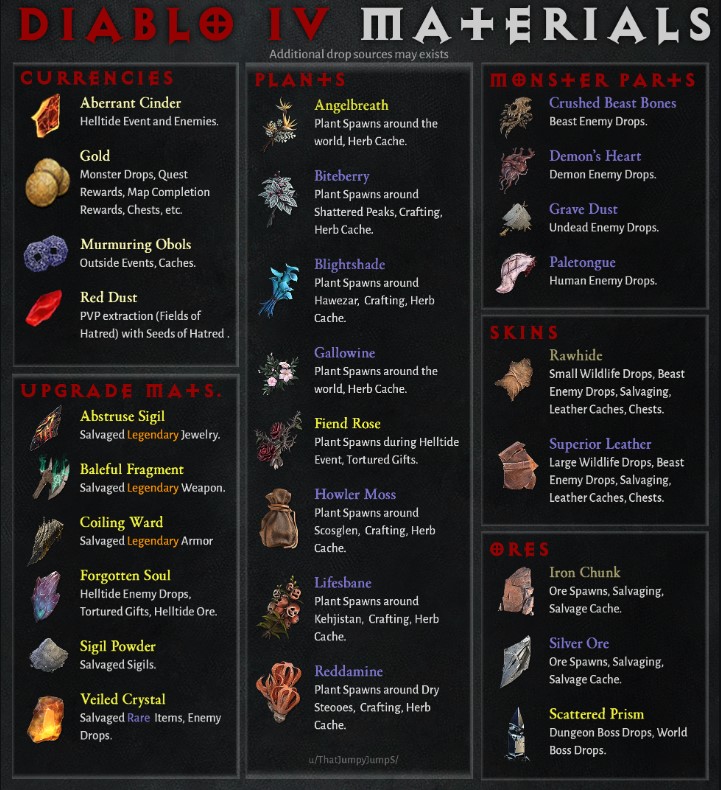
All Cube materials drop from a small set of activities, which is good news. Once you know the right rotation, you can stockpile fast and stop running out of dust mid craft.
Primordial Dust Sources
Primordial Dust is the universal currency of the Cube. Every recipe burns some amount of it, and there are eight tiers in total.
- Raw and Coarse Primordial Dust: War Plan caches and Tree of Whispers rewards
- Refined and Volatile Primordial Dust: War Plan caches, Tree of Whispers, and Elite monsters
- Pure, Enhanced, Attuned, Resonant Primordial Dust: Same sources, with better drop rates at higher Tormented tiers
War Plans are by far the best farm here. The activity tree progression unlocks Spoils of Greater Equipment at higher tiers, which means more materials per cache.
Tuning Prism Sources
All eight Tuning Prism types appear to share the same drop pool, based on current sources. They show up from War Plan caches, Tree of Whispers rewards, and elite monsters.
There is no targeted farm for a specific Prism type yet, so the move is to open caches in bulk and sort the inventory afterward.
- War Plan caches: reliable, multiple Prism types per cache
- Tree of Whispers caches: broadest cache pool, best for variety
- Elite monster drops: chance based, low rate, opportunistic only
Boss Trophies and Sigils
Boss Trophies feed the Amalgamation recipe to upgrade matching boss loot. Each lair boss drops a specific trophy, so you can stockpile them by farming the boss directly or by pulling them from caches.
Lair boss keys drop from War Plan activities, tortured gifts, hell tide chests, world bosses, and Tree of Whispers caches. Greater lair keys appear at Torment 6 and above.
The Crux of the False Prophet, which you need for the Echo of the False Prophet boss, drops at Torment 10 plus.
- Standard lair keys: War Plans, tortured gifts, hell tide chests, world bosses, Tree of Whispers
- Greater lair keys: Torment 6 and above
- Crux of the False Prophet: Torment 10 plus, very rare
Horadric Resin and Costs
Infused Horadric Resin is the dedicated Charm crafting material. It only comes from one place: salvaging Talisman Charms and Seals.
Build the habit of salvaging duplicates instead of vendoring them and you will rarely run out. High end recipes like Unique Power Reroll and Transfigure burn rare materials, so plan your stockpile before crafting.
- Resin source: salvage Talisman Charms and Seals only
- Rare materials to budget: Volatile, Attuned, Resonant Primordial Dust
- Habit: salvage duplicates instead of vendoring them
Material Farming Priority Order
If you want a clear daily farming priority, here is the order we recommend to keep the Cube fed without burning whole sessions on dead stockpile runs.
- War Plan activities first: Bonus loot, activity tree progression, highest dust drop rates
- Tree of Whispers second: Broadest cache pool, best for Tuning Prism variety
- Lair Boss runs third: Targeted boss trophy farming for Amalgamation recipes
- Hell Tide events fourth: Cinder farming for Hell's Price chests, plus tortured gifts for lair keys
- The Pit fifth: Pit completion bonus chests reward higher tier dust at Torment 4 plus
Pro Tip: Always go for War Plan tagged activities when you can. The activity tree multipliers stack in your favor over time, and pure non War Plan farming just cannot keep up.
Best Uses for the Horadric Cube in Endgame
Once you reach Tormented tier farming, the Cube becomes the central engine of your gear progression. Here are the highest value endgame plays, ranked by impact on character power.
The endgame loop in Diablo 4 is no longer farm and pray. It is farm, stockpile, craft, push. The Cube is the gear that keeps that flywheel turning.
- Highest impact: Recycle Uniques + Unique Power Reroll on Mythics
- Best value: Add Affix + Upgrade to Legendary combo
- Hidden gem: Amalgamate boss trophies for guaranteed boss loot pulls
Targeted Uniques
.jpg)
The Recycle Uniques recipe is the highest leverage farm in the game. Three copies of any Unique transmute into a fresh roll, which means you can stop praying for the perfect drop.
Build defining Uniques are all eligible for this play. Stack three copies, recycle, and repeat until you land a Greater Affix or perfect roll.
- Tyrael's Might - BUY HERE!
- Harlequin Crest - BUY HERE!
- Ahavarion Spear of Lycander - BUY HERE!
- Melted Heart of Selig - BUY HERE!
- Ring of Starless Skies - BUY HERE!
Mythic Crafting Strategy
Mythic Uniques are the apex of the loot pool. The Unique Power Reroll recipe lets you reroll the value of the unique power on any Ancestral Unique.
Pair this with Recycle Uniques for compound gains. Recycle three duplicate Mythics for a new roll, then Unique Power Reroll the result if needed.
Reminder: The Resplendent Spark cost is steep, but the payoff is permanent character power that lasts the whole season.
- Step 1: Stack 3 duplicate Mythics
- Step 2: Recycle for a fresh roll
- Step 3: Unique Power Reroll if the value is low
NEED HELP GETTING MYTHIC UNIQUES?
Sigil and Boss Material Conversion
The Amalgamation recipe upgrades duplicate consumables, socketables, and dungeon keys. The most valuable use is upgrading boss trophy materials into higher tier loot pulls.
Three Judicator's Masks, three Exquisite Blood, three Living Steel: each set transmutes into a higher reward chance for that boss. This is the cheapest path to specific boss Uniques without grinding the boss ten times in a row.
- Trio 1: 3x Judicator's Masks → Uravar boss loot
- Trio 2: 3x Exquisite Blood → Lord Zur boss loot
- Trio 3: 3x Living Steel → Gregor boss loot
Add Affix Plus Upgrade Combo
The cheapest power craft in the game is the Add Affix plus Upgrade to Legendary combo. Take a Rare item with two affixes, run Add Affix to push it to three, then run Upgrade to Legendary.
The result is a Legendary with three high quality affixes plus a Legendary power. Use a Tuning Prism on the Upgrade to Legendary step to bias the Legendary power toward the category you actually need.
- Recycle 3 Uniques for a fresh roll of the same Unique
- Unique Power Reroll on Mythics to maximize endgame stats
- Amalgamate boss trophies for guaranteed boss loot pulls
- Add Affix on a Rare, then Upgrade to Legendary for a double juiced item
- Transfigure amulets with Kullean Prism for permanent build defining aspects
Class Specific Cube Crafting Tips
Different classes care about different stats, which means different Tuning Prisms and different Cube priorities. Below is the highest impact Cube usage for each class.
Spiritborn

Spiritborn builds lean heavy on movement and AoE damage. Prioritize Pragmatic Tuning Prisms on amulets to roll movement speed and cooldown reduction.
- Weapons: Aggressive Prism on Chaotic Reroll for crit + vulnerable damage
- Amulets: Pragmatic Prism, then Kullean Transfigure
- Uniques: Recycle jaguar and gorilla aspect Uniques for Greater Affix rolls
Barbarian

Barbarian builds need resource generation to keep core skills firing. Use Resourceful Tuning Prisms on chest armor and pants to lock in fury generation.
Whirlwind and Rend builds get massive value from Recycle Uniques on Tyrael's Might and Doombringer.
- Chest/Pants: Resourceful Prism for fury generation
- Amulets: Adept's Prism for skill rank stacking
- Two handers: Add Affix + Upgrade to Legendary combo
Druid

Druid builds rely heavily on companion damage and shapeshifting bonuses. Run Adept's Tuning Prisms on amulets and helms to maximize skill ranks.
Pulverize and Lightning Shred builds get the highest value from Add Affix on rare two handed staves, then Upgrade to Legendary with Aggressive Prism guidance.
- Amulets/Helms: Adept's Prism for skill ranks
- Weapons: Aggressive Prism for offensive multipliers
- Two handed staves: Add Affix + Upgrade combo
Necromancer

Necromancer minion builds depend on minion damage modifiers and skill ranks. Stack Adept's Tuning Prisms on every gear slot you can.
Bone Spear and Bone Spirit builds care more about Aggressive Prisms on weapons. Set Charms drop randomly, so Cube rerolls are the only reliable path to a complete set.
- Minion builds: Adept's Prism everywhere
- Bone builds: Aggressive Prism on weapons
- Set bonuses: Reroll Set Charm recipe
Rogue

Rogue builds live and die by crit damage and vulnerable damage. Aggressive Tuning Prisms are basically mandatory on weapons, gloves, and amulets.
Twisting Blades builds get massive value from Transfigure with Kullean Prism on amulets. Aspects like Bursting Venoms and Encircling Blades can completely change a build's damage profile.
- Weapons/Gloves/Amulets: Aggressive Prism mandatory
- Amulet transfigure: Kullean for build defining aspects
- Bow builds: Reroll Set Charm for elemental damage stacking
Sorcerer

Sorcerers split between resource hungry channeled builds (Chain Lightning, Frozen Orb) and burst builds (Blizzard, Fireball).
Channeled builds need Resourceful Tuning Prisms for mana sustain. Burst builds prioritize Aggressive Prisms instead.
- Channeled builds: Resourceful Prism for mana sustain
- Burst builds: Aggressive Prism for damage stacking
- Amulet transfigure: Kullean Prism for elemental aspects
Warlock

The new Warlock class introduced in Lord of Hatred relies on demonic skill ranks and damage multipliers. Adept's Tuning Prisms on amulets and helms are critical.
Memphis Fulcrum set builds benefit massively from Reroll Set Charm. The 200% demon damage multiplier is build defining.
- Amulets/Helms: Adept's Prism for demonology skill ranks
- Memphis Fulcrum: Reroll Set Charm to complete the set
- Demonology Uniques: Recycle for Greater Affix versions
Tips, Tricks and Common Mistakes
Here is the field tested guidance for getting maximum value out of the Cube without bricking your best items. Veterans learn these lessons the expensive way.
- Always use a Kullean Prism on amulet transfigures. Without it, current sources suggest a near guaranteed Unmodifiable result.
- Do not transfigure your only copy of a Mythic Unique. Wait until you have spares, then gamble.
- Adjust your loot filter: Keep at least one of each rarity tier visible. Common and Magic items are essential Cube fuel.
- Run only War Plan activities when you can. The activity tree multipliers stack massively over hours of play.
- Add Affix before Upgrade to Legendary. Doubling up gets you a stronger Legendary than upgrading directly.
- Stockpile boss trophies in threes. Amalgamation needs sets of three. One or two random rolls are wasted inventory.
- Use Focused Reroll, not Chaotic Reroll, when you already have the right category. More efficient for fine tuning.
- Save Volatile Primordial Dust for transfiguration. Do not waste it on cheaper recipes.
- Mark Greater Affix items in your loot filter. Recolor them to red so you never accidentally salvage one.
- Salvage charms and seals, do not vendor them. Infused Horadric Resin only comes from salvage.
Common mistake: spamming Chaotic Reroll without a Tuning Prism. You will roll into garbage categories almost every time. Always use the matching Prism.
F.A.Q.
1. When does the Horadric Cube unlock in Diablo 4?
Based on current sources, the Cube unlocks at the end of The Land of Fire questline, the final region of the Lord of Hatred campaign. Once you finish the campaign on one character, the Cube is account wide.
2. What is the most important Cube recipe?
For most players, Recycle Uniques is the highest leverage recipe. Three copies of any Unique transmute into a fresh roll, which removes the random drop dependency from your build.
3. Can I transfigure any item?
Only Legendary, Unique, and Mythic items can be transfigured. The recipe is most powerful on amulets paired with a Kullean Tuning Prism, which adds a random Legendary Aspect.
4. What is the Kullean Tuning Prism for?
The Kullean Tuning Prism is the dedicated transfiguration material. On amulets, it adds a Legendary Aspect and dramatically reduces the chance of rolling Unmodifiable.
5. What is an Unmodifiable item?
Unmodifiable items cannot be tempered, masterworked, or further Cube edited. They are frozen in their current state. Most players treat Unmodifiable as bricking the item permanently.
6. Where do I farm Primordial Dust?
War Plan caches and Tree of Whispers rewards are the primary sources. Higher tiers (Pure, Enhanced, Attuned, Resonant) seem to drop more frequently at Tormented 4 and above.
7. Can I upgrade a Common item to Unique?
Yes. The Upgrade to Unique recipe transmutes a Common (white) item into a random Unique of the same type. Costs 1 Enhanced Primordial Dust and 10 Raw Primordial Dust.
8. How do I craft Runes with the Cube?
The Ritual Rune and Invocation Rune recipes craft specific Runes from 5 Legendary Runes plus 5 Rare Runes plus a specific Magic Rune. The only reliable way to target an exact Rune.
9. Can I reroll a low roll Mythic Unique?
Yes. The Unique Power Reroll recipe randomizes the value of the Unique power on any Ancestral Unique, including Mythic. Each reroll costs 1 Attuned Primordial Dust and 100 Raw Primordial Dust.
10. Is the Horadric Cube worth using before endgame?
Yes. The Add Affix recipe is useful from the moment you unlock the Cube. Save advanced recipes like Transfigure and Unique Power Reroll for Tormented tier farming.
Final Thoughts
The Horadric Cube is the single most important system added in Lord of Hatred. Once you understand it, your relationship with loot completely changes. You stop praying for perfect drops and start engineering them.
Whether you are still leveling or already pushing Tormented tiers, the Cube has something for you. The trick is knowing which recipes to prioritize and which materials to save for later.
Key Takeaways
- Stop salvaging blues and yellows on sight. They are essential Cube fuel.
- Always use a Kullean Prism when transfiguring an amulet. Skip the Unmodifiable gamble.
- Recycle Uniques is the highest leverage recipe in the entire Cube. Stack three, recycle, repeat.
- Run only War Plan activities for the bonus loot multipliers.
- Save Volatile Primordial Dust for transfigures and Mythic rerolls only.
If the material grind is taking over your free time, our Diablo 4 boosting services handle the farming, the campaign progression, and the endgame pushes for you.
Final word: Lord of Hatred is fresh content, so keep an eye out for patch updates. We will refresh this guide as official databases catch up with the live build. For now, follow the careful wording on uncertain values and lean on the confirmed mechanics.